On this page
Evaluate an AI customer support employee by the questions it can resolve from reliable sources, the actions it is authorized to take, its human handoff and cost per accepted outcome. Reply count alone does not establish good service, and “digital employee” does not imply unlimited autonomy.
This guide explains HyoNova's model and published prices reviewed on 28 October 2026. Images show production version 87663bba1 in a fictional demo company. AI wording is scripted for explanation, not evidence of accuracy, resolution rate or sales growth.
What distinguishes the workflow from a chatbot?
Labels matter less than behavior. A chatbot can be sophisticated and a product called an employee can be limited. Ask whether it can retrieve approved knowledge, use permitted customer context, create or update a ticket, request approval, record actions and stop at its authority boundary.
The HyoNova AI Support Employee is described for web chat, email, tickets and connected channels, with knowledge, CRM context, human escalation, audit and budget controls. Channels require their own configuration and approvals. An icon does not mean every social message, comment or call works automatically.
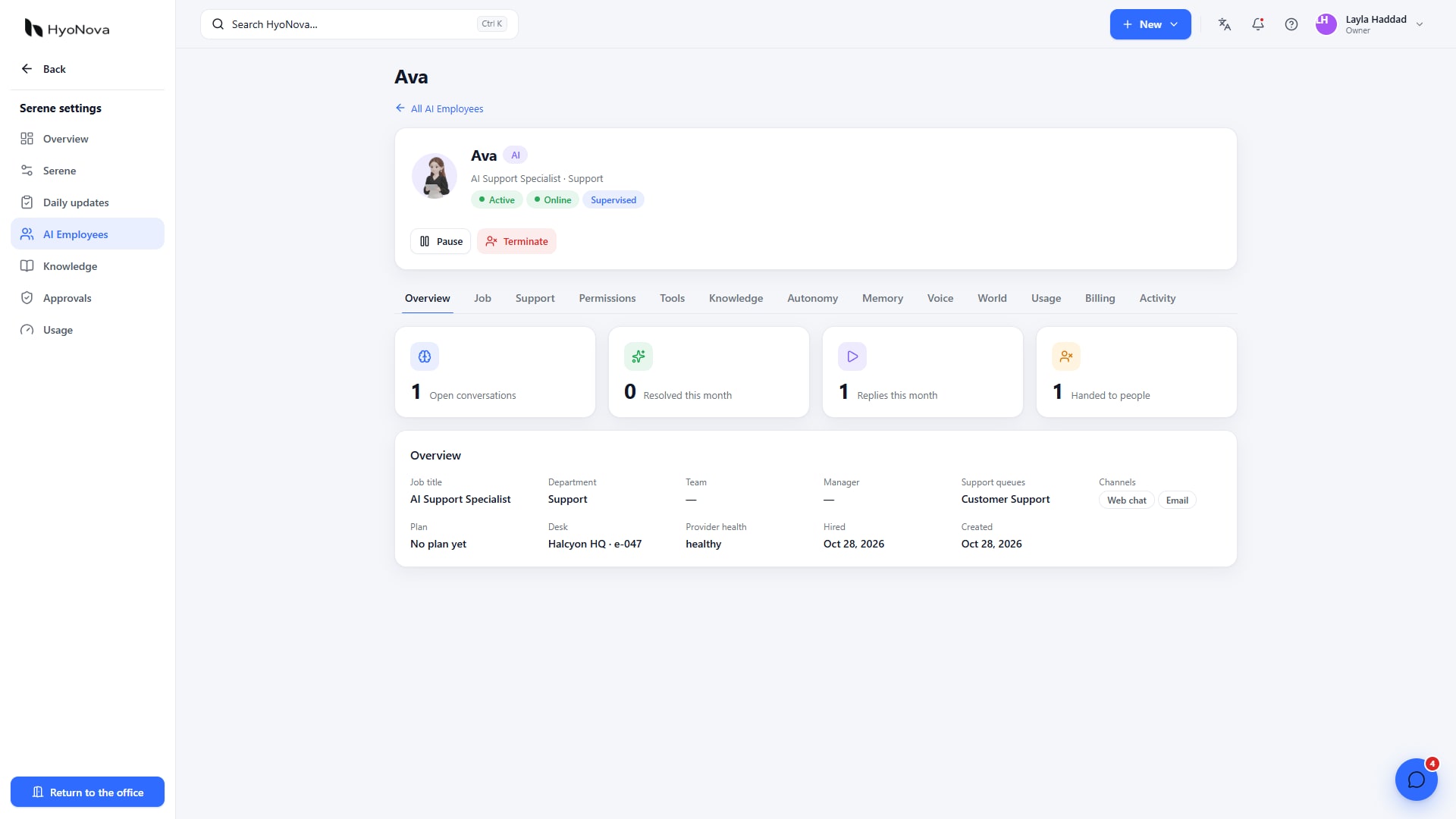
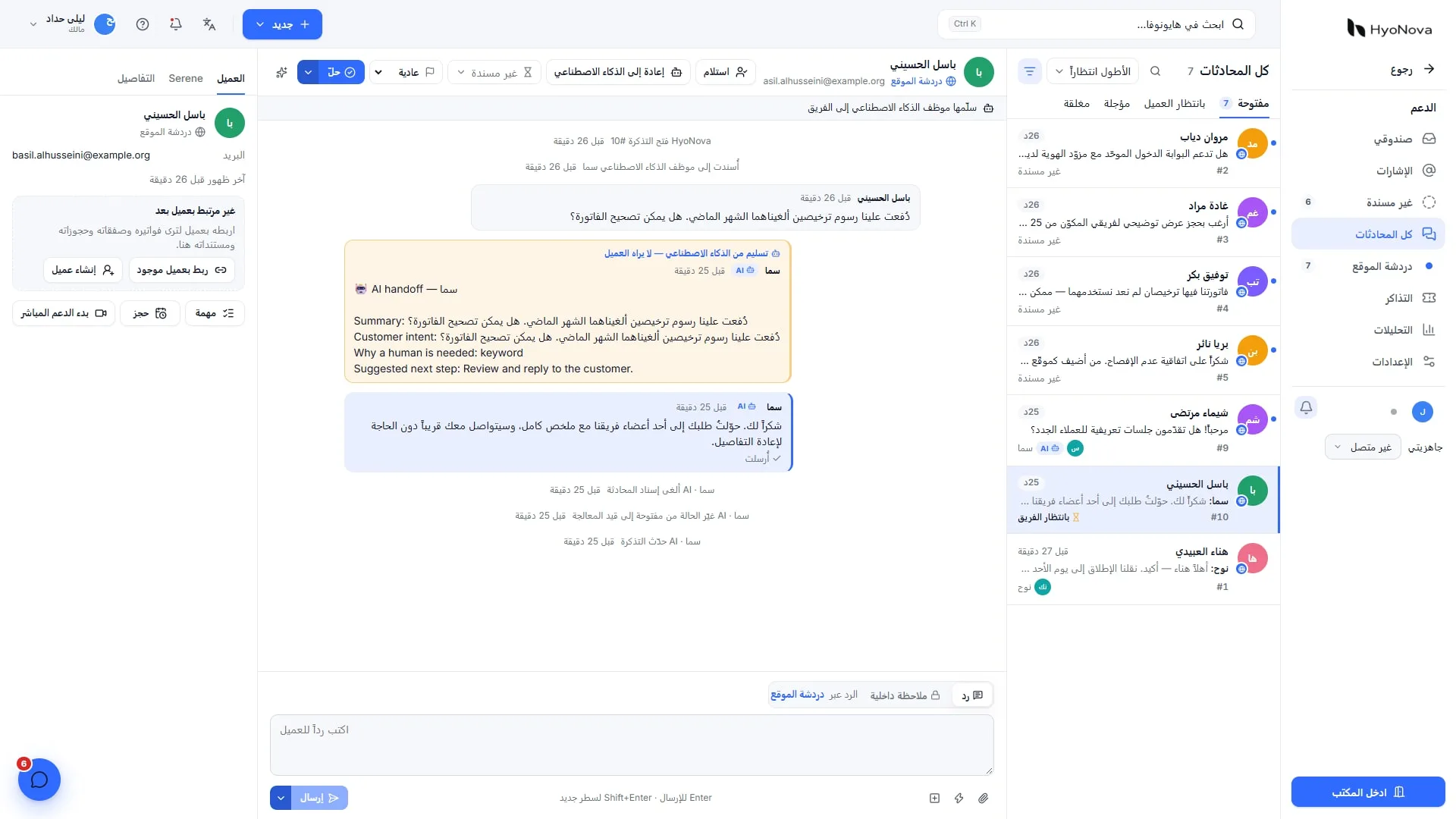
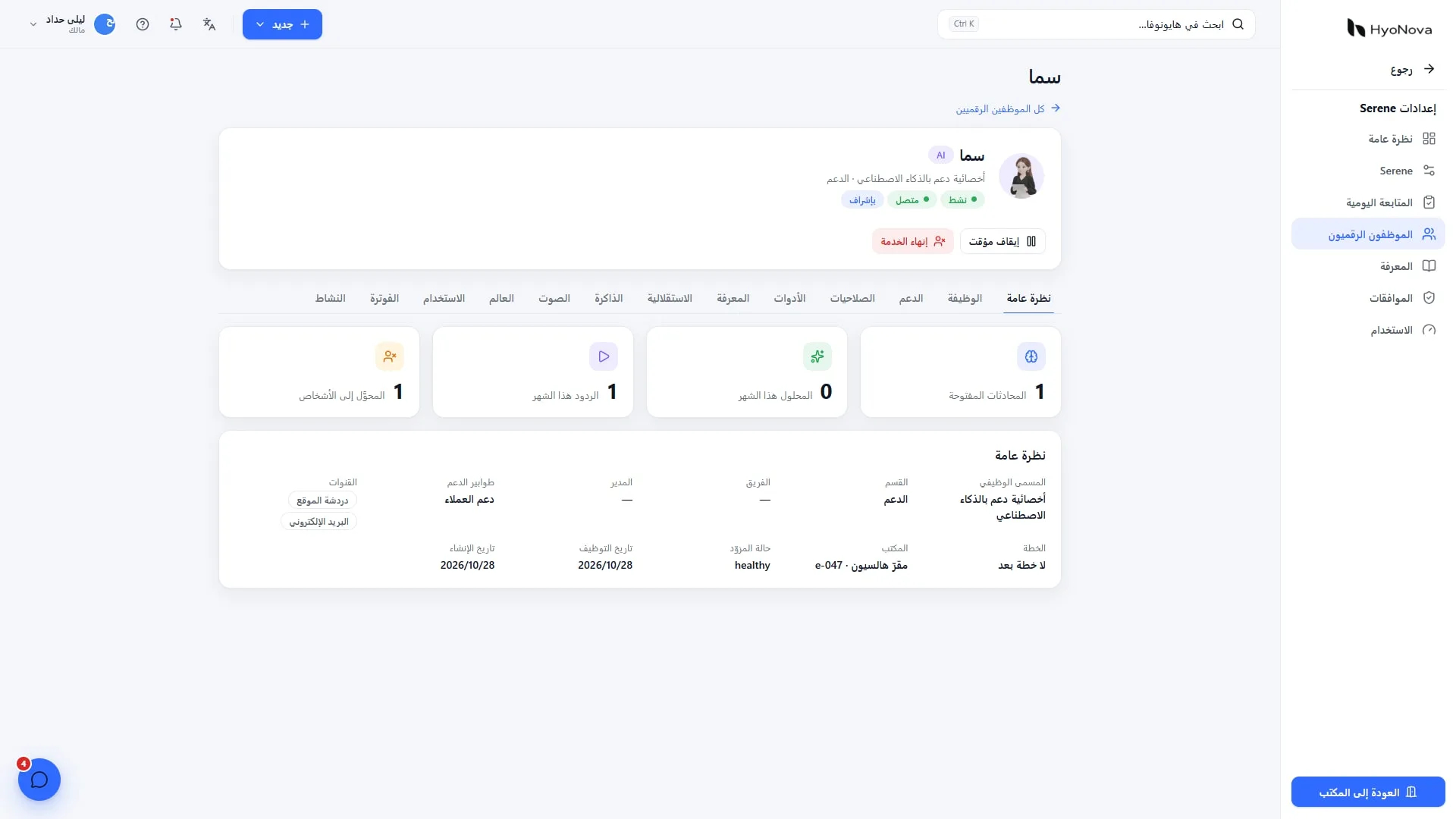
Actual product capture from a local demo on production version 87663bba1, captured on 28 October 2026. Fictional data. AI responses are scripted for demonstration, not an evaluation of model quality.
Prepare knowledge before answers
Collect FAQs, policies and current prices with an owner and review date.
Separate public sources from restricted customer, employee and finance records.
Define which requests require identity checks, approval or escalation.
Write an uncertainty route instead of encouraging invented answers.
Update knowledge after a policy or price change, not only after complaints.
Start with a bounded, auditable scope such as product questions and account guidance. Do not begin with authority to issue refunds, change subscriptions or make commercial commitments without reviewing actual permissions and approval controls.
When should a person take over?
Case | Appropriate route |
|---|---|
Missing or contradictory sources | Acknowledge uncertainty and pass the question with context |
Customer requests a person | Offer handoff without forcing a long repeated sequence |
Repeated complaint or reopened conversation | Review the cause and previous decision rather than repeating the same answer |
Request outside authority | Stop and request the appropriate approval |
Sensitive information or identity conflict | Follow the company's verification policy |
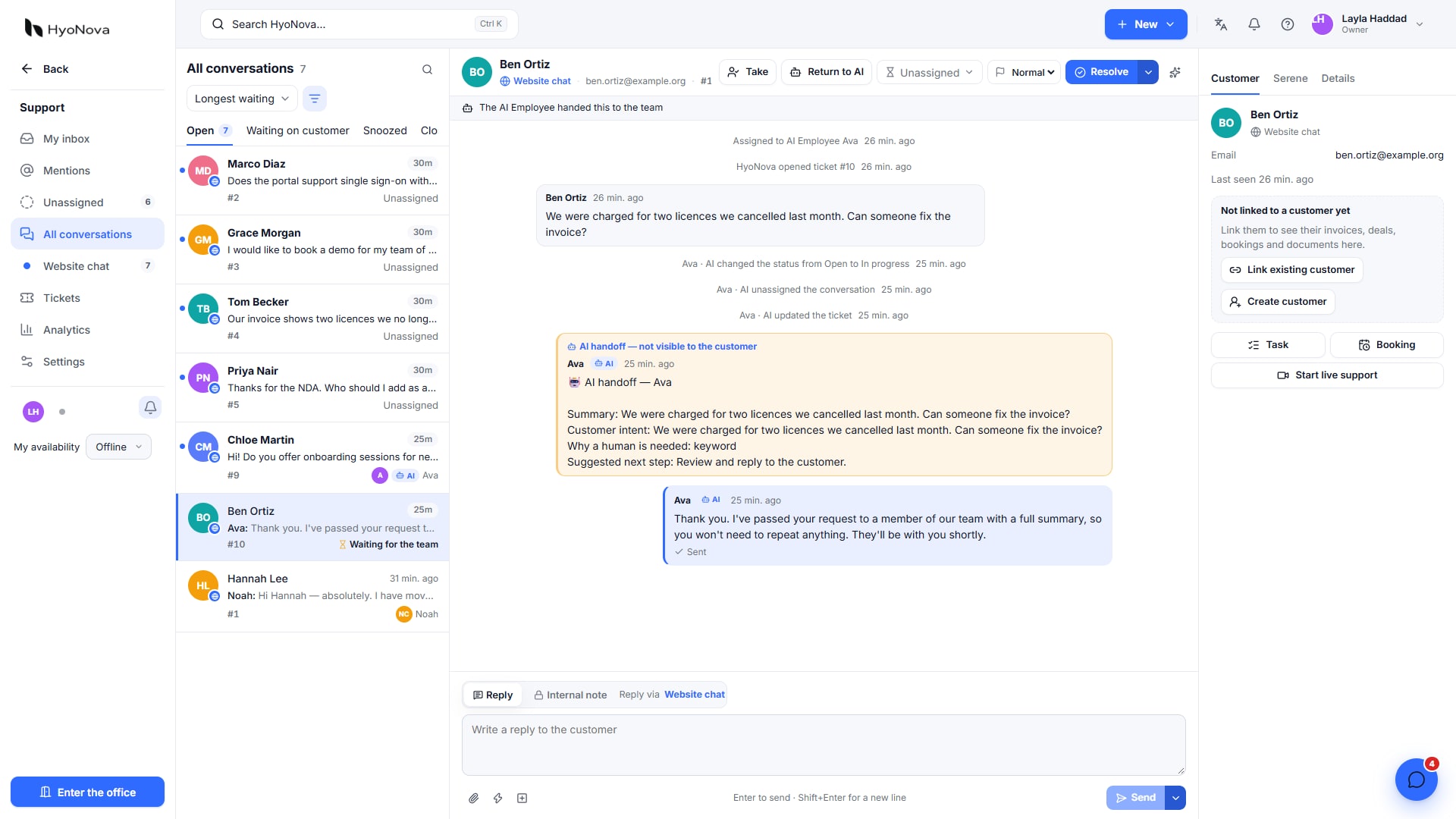
Actual product capture from a local demo on production version 87663bba1, captured on 28 October 2026. Fictional data. AI responses are scripted for demonstration, not an evaluation of model quality.
Give the receiving team the original request, previous AI answer, relevant source or action and reason for escalation. Explain after-hours behavior too: logical AI availability does not establish around-the-clock human staffing.
Published price and consumption units
Item | Published amount |
|---|---|
AI Support Employee | $149 monthly or $1,428 annually, equivalent to $119/month |
Monthly inclusion | 500 AI-resolved outcomes and 300 in-world AI voice minutes |
Outcome add-on | 500 extra outcomes for $99 |
Voice add-on | 500 extra minutes for $49 |
Add-on validity | 12 months from purchase |
A recurring monthly allowance differs from an add-on balance valid for 12 months. Do not assume unused monthly allowance rolls over or that packs renew free. An outcome is a conversation resolved without human takeover, not every message or ticket received. Voice is inside the virtual world, not telephone or WhatsApp calling. Confirm activation and the required company plan in your account.
Calculate effective resolution cost
On monthly billing, divide cost by outcomes actually achieved and accepted. $149 divided by 300 is about $0.50; at 500 outcomes it is about $0.30. These are budget calculations, not a promise that AI will resolve that volume.
If a month requires 800 outcomes and you buy one 500-outcome pack, the example's cash payment is $248 before the team plan, tax and extra voice. Dividing by 800 gives $0.31, with 200 add-on outcomes left if consumption follows those assumptions. Track remaining pack balances and expiry rather than confusing purchased capacity with consumed cost.
Include knowledge maintenance, channel setup, escalation and reopened-conversation review. Real savings depend on acceptable resolution quality and operating effort. Do not compare a subscription with a person's salary while assuming their whole role disappears.
Acceptance testing before expansion
Build fictional questions covering a sourced answer, an unsourced request, private-data access and human handoff. Include Arabic and English and inspect reopened conversations. This is a proposed test protocol, not a published result.
Measure source-correct answers, successful handoffs, material corrections and cost per conversation the team accepts as resolved. Begin with substantial human review and expand only after understanding failure cases.
Privacy and next steps
Read AI data use and security before adding knowledge. Serene team assistance and a billed Support Employee differ in purpose and charging. Start with the support workflow and name knowledge and escalation owners before activation.