On this page
- Why social customer service affects sales opportunities
- Three channels, one consistent response process
- A six-step response workflow that supports selling
- Add a HyoNova AI Support Employee to customer intake
- How much does an AI Support Employee cost?
- Measure the effect on sales, not just message speed
- Prepare the digital employee, then test over two weeks
- Respect channel policies and keep a human route visible
- Give every inquiry a clear next step
- Frequently asked questions
The advertisement works. A visitor asks an Instagram question about your service. Another customer messages on WhatsApp about the price. Someone on Facebook wants to understand delivery. If useful answers never arrive, the campaign has created an opportunity the business is not ready to receive.
Replying to customers is part of the sales process, not an administrative task after publishing content. A good response removes uncertainty, helps the buyer choose an appropriate next step and gives a responsible person ownership. Speed matters, but an instant acknowledgment is not the same as a useful answer.
Reviewed on 28 October 2026. This practical guide is written by the HyoNova team. The link between service and sales is a description of the buying process, not a promise of a fixed uplift. Examples are hypothetical. Prices are in US dollars and can change.
Why social customer service affects sales opportunities
A customer asking about availability, price or implementation is trying to remove an obstacle to a decision. An accurate answer can move the conversation toward a proposal or purchase. An incomplete answer forces another question or another search. Without a shared record, even a later purchase may be disconnected from the conversation that helped it happen.
The 2025 Sprout Social Index findings report that 73% of social users expect brands to reply within 24 hours. This is vendor research about expectations, not a universal rule for every market or evidence of a particular sales uplift. Set a service promise for your audience and measure whether you keep it.
Before purchase: resolve the objection
A pricing question may be a suitability question. Explain what the offer includes, ask one qualification question when necessary and provide a clear next step. Avoid turning a simple inquiry into an interrogation. Do not promise an unapproved discount or delivery commitment merely to keep the conversation moving.
After purchase: protect trust
An unresolved delivery problem is not the right moment for another promotion. Establish ownership and the next update first. Helpful support may improve the relationship, but look for evidence in repeat orders, satisfaction and complaint patterns rather than claiming an automatic revenue increase.
Three channels, one consistent response process
Channel | Common situation | Useful response | Avoid |
|---|---|---|---|
A direct service or price inquiry | A concise answer and a clear next step | Repeated promotional follow-up without appropriate permission | |
A message after seeing a product or post | Clarify the reference and answer with context | Making the customer restart at every handoff | |
Facebook / Messenger | A company-page inquiry | Explain the service and move private details to a private route | Publishing customer or order information in a public comment |
Separate private messaging from public comment management. A unified messaging inbox does not automatically publish content, monitor every mention or moderate every comment. Test the connection scope your business actually needs and assign responsibility for activity outside it.
A six-step response workflow that supports selling
Capture the conversation: Do not let one employee's personal device become the only company record.
Identify intent: Distinguish a buying question, an existing order, a complaint and a specialist request.
Answer from approved knowledge: Use accurate terms and acknowledge what needs verification.
Offer one next step: A relevant proposal, a booking or a handoff to the responsible person.
Record the outcome: Was the issue resolved? Was an opportunity created? Who follows up?
Review quality: Track reopened issues and answer accuracy alongside response speed.
An illustrative service-company reply might be: “Welcome. This package includes account setup and team onboarding. How many people will use the service? If you prefer, I can connect you with the team for a detailed proposal.” Adapt the wording to your real offer. Do not insert prices or deadlines your business cannot honor.
Add a HyoNova AI Support Employee to customer intake
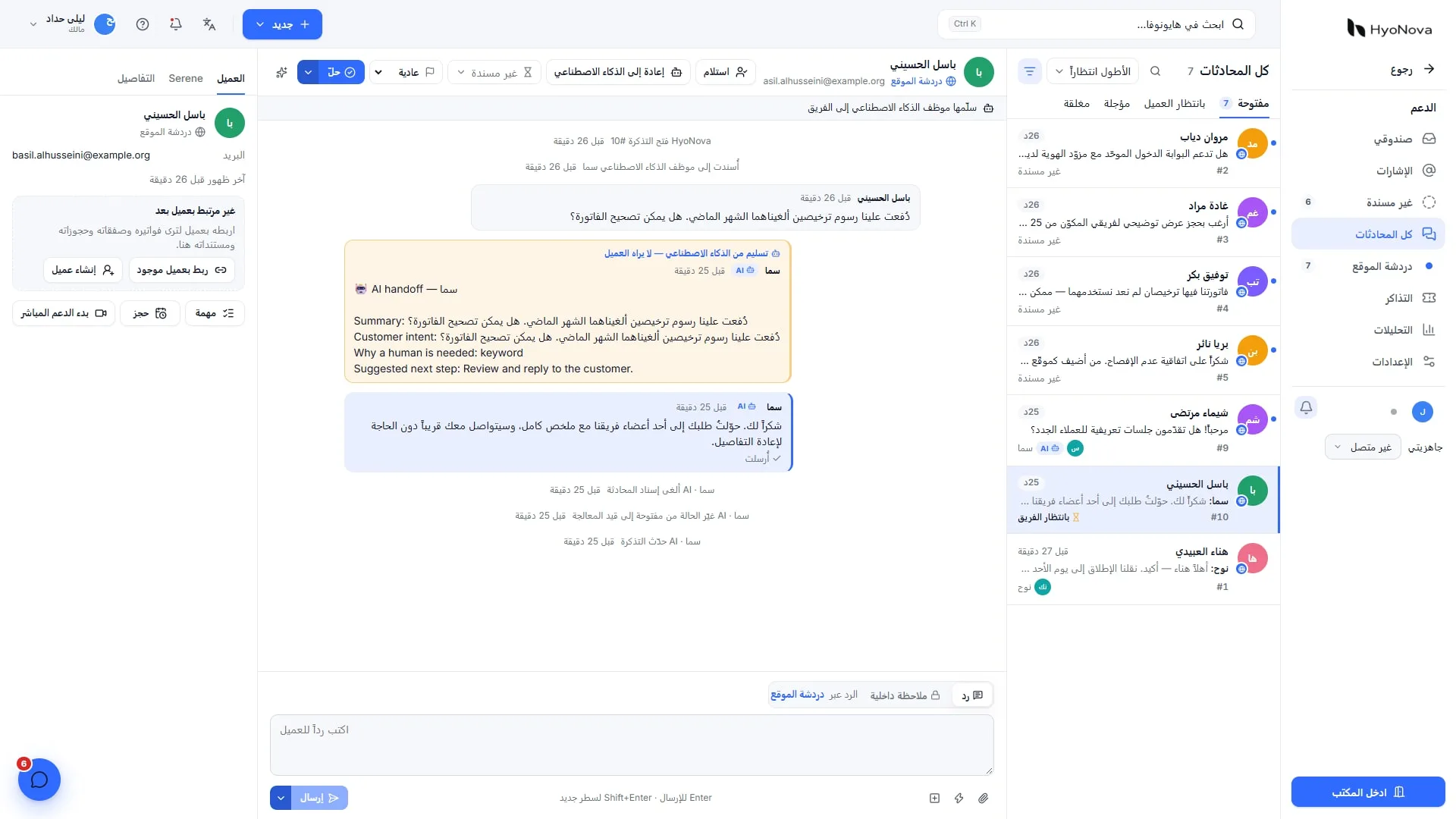
For repeated questions, consider the HyoNova AI Support Employee. It uses approved knowledge and customer context, then hands unresolved conversations to people. Customers can reach it at any hour; that describes availability, not continuous computing or guaranteed resolution.
HyoNova Support can bring web chat, email, WhatsApp, Instagram and Messenger into one inbox after channel setup. Validate your accounts, permissions and message flow before relying on the connection. This does not establish automatic access to personal accounts or every public-comment format.
Start with one defined scenario. Supply your real services, common questions and approved policies, and name the human owner for escalation. The digital employee can support the buying journey within configured permissions. Do not present it as a sales representative authorized to issue discounts, refunds or inventory changes without verified tools and authorization.
How much does an AI Support Employee cost?
Option | Published price | Capacity |
|---|---|---|
Monthly subscription | $149 per AI Employee per month | 500 AI-resolved support outcomes and 300 in-world voice minutes monthly |
Annual billing | $1,428 per year; equivalent to $119 per month | The same monthly capacity |
Extra outcome pack | $99 | 500 outcomes, valid for 12 months |
Extra voice pack | $49 | 500 minutes, valid for 12 months |
An outcome is a conversation resolved without human takeover. Voice minutes are for Nova World, not phone calls or WhatsApp voice. The AI Employee is a separate add-on; messaging-provider charges may apply. Check current details.
Measure the effect on sales, not just message speed
Connect qualified inquiries to verifiable outcomes: a proposal, appointment, purchase or an unsuitable request. Track median response time and the slower portion of the queue alongside the average. A handful of fast replies can hide long waits elsewhere. Measure resolution as well as the first response.
Metric | What it helps you understand |
|---|---|
First useful response time | How long the customer waits for progress, separately from an acknowledgment |
Qualified conversation conversion | Attributed orders divided by qualified conversations in a defined period |
Resolution, reopening and escalation | Whether the issue is actually solved rather than closed prematurely |
Customer satisfaction | How respondents rate the experience, allowing for response bias |
Cost per meaningful outcome | Complete operating cost divided by a relevant result |
Hypothetical scenario, not a forecast: A company receives 300 qualified buying conversations monthly. A 10% conversion rate produces 30 orders. If a comparable test achieves 13%, it produces 39. At $25 contribution per order before response-system costs, the nine additional orders contribute $225. Deduct subscription, setup, staffing and messaging costs. Do not attribute the difference entirely to AI if the offer, traffic sources or ad budget changed at the same time.
Prepare the digital employee, then test over two weeks
Days 1–3: Collect common questions and approve the answers and boundaries. Define immediate human escalations: financial disputes, repeated complaints, missing facts or a direct request for a person.
Days 4–7: Test the languages and dialects your customers use, including ambiguous questions. Review the record. Begin with one channel and a narrow question set. Good language output alone is not a reason to grant financial permissions.
Days 8–14: Track response, resolution, escalation and conversion using comparable groups where feasible. Correct knowledge gaps causing repeated errors. Expand only after the workflow works for real customers.
Respect channel policies and keep a human route visible
The WhatsApp Business Messaging Policy requires approved templates outside the Business Platform's 24-hour customer-service window, alongside permission requirements and direct escalation paths. Check the current rules for your account and provider. AI does not remove those requirements or include unlimited third-party messages.
Tell customers when they are interacting with a digital assistant, and make requesting a person straightforward. Avoid requesting sensitive payment details in chat or exposing private customer information publicly. A process people can review is more useful than claiming the system can never make a mistake.
Give every inquiry a clear next step
If messages are scattered across devices and accounts, unify intake first. Add AI for repeatable questions using approved knowledge and permissions. Create your company in HyoNova and explore the AI Support Employee. Start with a workflow your team can measure and review before expanding.
Frequently asked questions
Does a faster response guarantee more sales?
No. It reduces waiting, but suitability, pricing, accuracy and service quality also matter. Test business outcomes rather than assuming a fixed conversion gain.
Does the AI Employee replace the whole support team?
Start with repeatable questions. Keep people responsible for judgment, exceptions and escalation, especially when a customer asks for human help.
Will activation connect every social account automatically?
No. Accounts, channels and permissions need setup and testing. Evaluate private messaging separately from publishing and public-comment management.
Is the AI Employee part of the ordinary helpdesk subscription?
It is a separate paid add-on. Include your company plan, AI capacity, possible channel charges and knowledge-preparation time when evaluating the purchase.